Agency Operations · Playbook
Most agency reports still lead with rankings and traffic spikes. Clients ask for something quieter: proof that work moved indexing health, opportunity quality, and pipeline risk.
This playbook shows how to build seo client reporting that reads like an ops brief, not a vanity slide deck. Use it to tighten your client seo report template, choose reporting tools with judgment still in the loop, and keep a soft path to EffectiveRank early access when evidence collection is the bottleneck.
No ranking guarantees. No indexing promises. Just a structure that holds up when a client asks "so what changed?"
The gap between what most seo client reports show and what clients actually need to decide is wider than it looks. Board-level questions are about business exposure, not chart color. Start by separating the two.
Separate board questions from dashboard decoration.
Pipeline risk, coverage of money pages, and delivery confidence are decisions. Impression charts with no action attached are decoration. Label each metric accordingly before it goes into a report.
Ask each client for three decisions the report should support this month.
Then map every metric back to one of those three decisions. If a number cannot be mapped, it does not ship in the main body.
Keep rankings as context, not as the headline KPI.
Rankings belong in a report when they explain a business risk or a content gap. Leading with a position-1 screenshot when conversion is the client's actual concern is noise.
Document "non-goals" for the report explicitly.
State which metrics you are not featuring this cycle and why. It builds trust and stops recurring requests for charts that do not change prioritization.
Replace screenshot dumps with one sentence of interpretation per chart.
What changed, why it matters, what you will do next. A chart without that sentence is a data transfer, not a client seo report.
Review last quarter's client questions and retire stale metrics.
Any metric that never drove a follow-up task across four reports is carrying its own weight without paying rent. Cut it.

Evidence-first reporting reads like an ops brief, not a vanity deck.
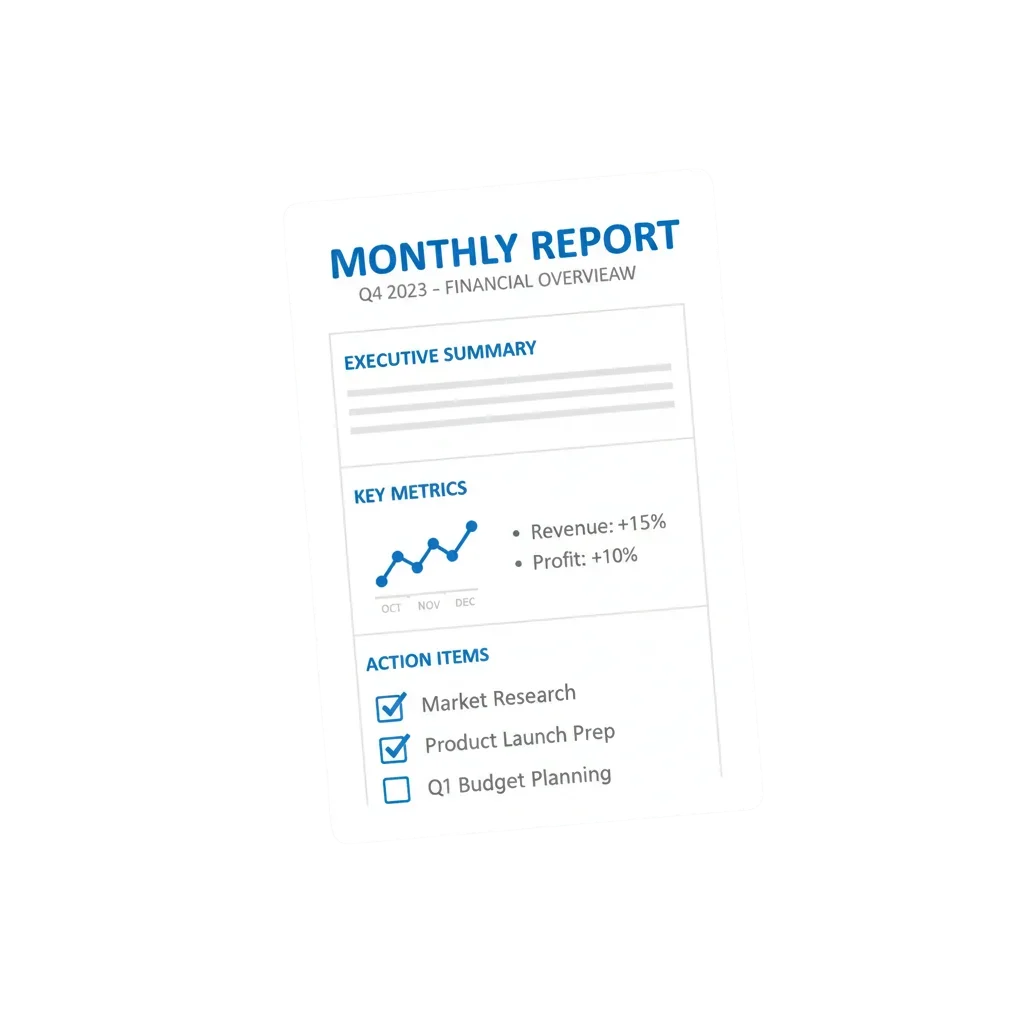
A seo monthly report template that holds up under client questioning starts with a fixed skeleton, then fills each section with living evidence rather than recycled prose. Here is the structure account leads at most agencies converge on after a few painful reviews.
SEO monthly report template - fixed skeleton
Scope and goals
Restate what this period's work was scoped to achieve and which client decisions it was meant to inform. One short paragraph.
Delivery log
A plain list of shipped tasks with ticket IDs or dates. If it was recommended but not implemented, say so and log the owner.
Indexing and crawl health
Coverage of priority URLs, any regressions detected (noindex shifts, canonical changes, broken links), and the hypothesis for each unresolved state.
Opportunity pipeline
Striking-distance queries, high-impression low-CTR pages, and internal linking gaps. Each with a next experiment defined.
Experiments
What was tested, what signal you got, what the next step is. Keep this section short; depth belongs in a separate test log.
Asks for the client
Content approvals, dev access, stakeholder calls, or budget decisions needed before the next cycle can proceed. One list, one owner per item.
Attach evidence links beside every claim - Search Console exports, crawl diffs, and ticket IDs - so readers can audit without booking a call.
Cap vanity tables. If a metric cannot change next month's backlog, move it to an appendix rather than cutting it entirely.
End each section with an explicit owner and due window for the next check. Vague language like "monitor" gives no one accountability.
Version the template so account leads share the same skeleton across clients while still allowing custom inserts per relationship tier.
Indexing data is the section most agencies either skip or paste in raw. Neither option is useful. The goal is a short chain: situation, evidence, interpretation, next experiment. No filler adjectives, no sitewide averages hiding money-page problems.
Priority URL coverage first
Lead indexing with coverage of priority URLs, not sitewide averages. A 97% index rate looks fine until it turns out the three missing pages are your client's top product templates.
Translate status states into client language
Translate states like "Crawled - currently not indexed" into plain language: discovery happened, selection did not, here is the hypothesis and the test. See this primer if your team needs background on that state before the next client call.
Pair indexing claims with opportunity evidence
Which templates or clusters are candidates for indexing improvement, why, and what content or technical change is already queued. Indexing data alone is a problem statement; paired with opportunity data it becomes a direction.
Before/after snapshots of small URL sets
Prefer a before/after snapshot of 10-20 priority URLs over global percent changes that look dramatic and mean little. Concrete URL tables survive client scrutiny; aggregate numbers rarely do.
Situation. Evidence. Interpretation. Next experiment.
That four-part structure is the whole indexing section. If you cannot fill all four parts, the analysis is not finished yet.
The choice between white-labelling seo reporting tools and showing co-branded or fully branded outputs is a business decision, not a design preference. Both have real ops costs that are easy to underestimate at contract time.
White-label
Branded or co-branded
One question to ask before signing any tool contract
Document who owns data accuracy in each reporting model. If a number is wrong in a client report, which party is accountable, and what is the correction process? Disputes stall monthly reviews when this is not written down.
Mixing the two rhythms is the single most common reporting failure at mid-size agencies. Weekly ops and monthly business reviews answer different questions for different audiences. Keeping them separate saves time on both ends.
Weekly ops
Monthly business review
The goal of automation in seo client reporting is to eliminate the data-pull grind, not to automate the "so what." SEO reporting tools are useful for charts, exports, and scheduled pulls. They are not a substitute for the analyst who reads the numbers and writes the interpretation.
Search Console exports, crawl snapshots, ticket system status, and uptime checks can all land in a staging sheet or warehouse on a schedule. That part has no judgment in it and should not take your analyst's morning.
Interpretation, prioritization, and honesty checks stay manual before the report goes to a client. Automation should never write the "so what" paragraph. If it does, the client is getting the tool's opinion, not the agency's.
A missing export that becomes a blank claim is a trust problem, not a technical one. Make automation failures loud: a broken pull should alert the account lead, not silently produce an empty chart.
Use seo reporting tools for charts and exports, not for narrative. Template the repeatable prose (definitions, methodology footnotes) and rewrite the living interpretation each cycle.
If evidence collection is the bottleneck, that is usually a crawl and index signal problem, not a writing problem. Fixing the data pipeline before improving the prose structure is almost always the right order.
Evidence collection
If collecting crawl and index evidence for client packs is eating your week, EffectiveRank early access is built for agencies that want clearer signals in seo client reporting, not louder charts. Start from the product overview if you need the short version first.
No guarantees on rankings or indexing outcomes. Bring your judgment, use the evidence.
A report built on this playbook tells the client four things without using those exact words: what you shipped, what you measured, where the open risks sit, and what decision you need from them before the next cycle. That is it.
Clients who ask "so what changed?" are almost always asking because nothing in the last report pointed to a decision. The fix is structural, not stylistic. Once the skeleton is right, the style follows.
Quick checklist before sending any client seo report
When evidence collection is the bottleneck
If pulling crawl snapshots and indexing signals into your seo client reporting pack is the slowest part of the month, that is a workflow problem worth fixing before the next cycle.
EffectiveRank is built for agencies managing multiple client sites. It connects Search Console, runs crawls, detects regressions, and produces a daily prioritized worklist with the evidence behind each item. Bring your judgment. Use the signals.
No guarantees on rankings or indexing outcomes. Recommendations are evidence-based and user-reviewed.
What EffectiveRank adds to reporting
Early access packaging. May change before general billing opens.
EffectiveRank is not affiliated with Google. Search Console data is accessed via supported APIs where available. Nothing in this playbook constitutes a guarantee of rankings, indexing coverage, or traffic outcomes. Primary keyword: seo client reporting. Related: client seo report, seo monthly report template, seo reporting tools.